Suspension and Steering Repair in North Bay
AutoNorth Auto Repair is a licensed North Bay shop that repairs suspension and steering at 1520 Cholette St, covering struts, shocks, springs, control arms, ball joints, tie rods, sway bar links, bushings, wheel bearings, CV axles and power steering. Frost heave, potholes, gravel roads and six months of road salt wear these components out faster here than the odometer suggests, so AutoNorth finds the part that actually failed, shows you a photo of it, and quotes the repair before any work starts.
Last updated August 7, 2026
How Much Does Suspension Repair Cost in North Bay?
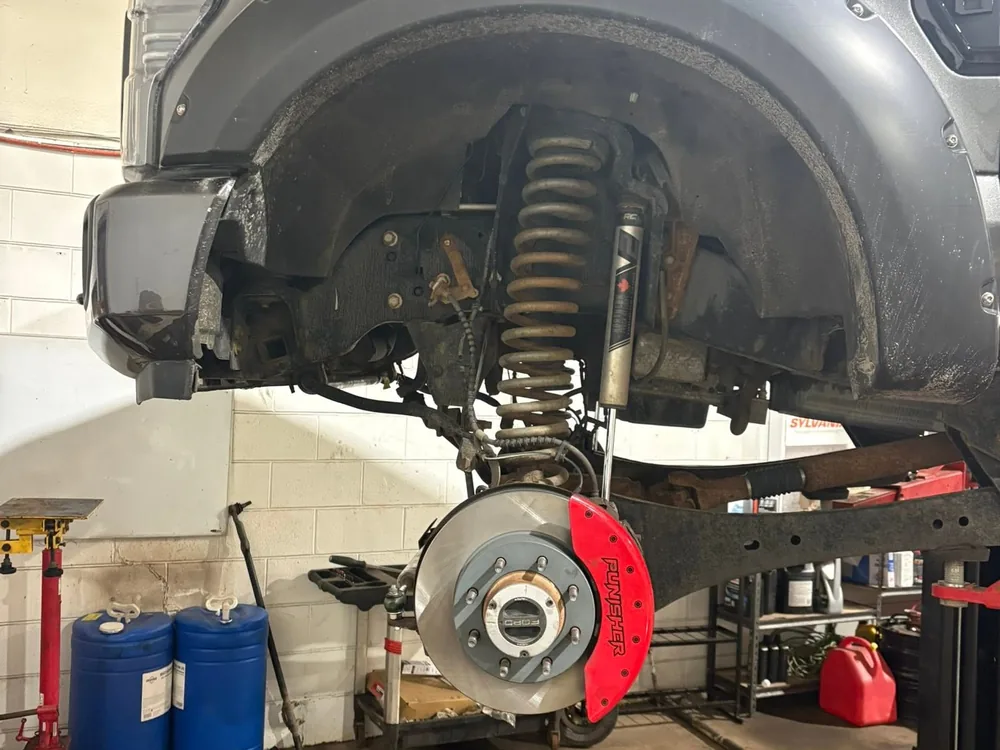
Suspension repair costs whatever the vehicle actually needs, and no honest shop can put a number on that over the phone. AutoNorth puts the vehicle on the hoist, works out which components are worn and which are still fine, and quotes the job before any work starts.
- Which component failed. A pair of sway bar links and a pair of front struts are not the same conversation. Links are small parts and modest labour. Struts carry the spring and the ride height, and replacing them is a bigger job at both ends of the bill.
- How many corners are involved. One worn ball joint is one repair. Four corners that have all done the same kilometres of Highway 11 and gravel is a different quote, and it is often worth doing in a planned order.
- What the vehicle is. A compact commuter, a loaded three-quarter-ton pickup and an independent rear suspension on a European car all price differently, because the parts differ and so does the time to get at them.
- How much of it is seized. This is the northern Ontario tax. Road salt welds bolts into bushings and turns a two-hour job into a longer one. Heat, penetrant and patience are sometimes a real line on a suspension invoice, and pretending otherwise before the wheel comes off would be guessing.
- Whether an alignment follows. Replacing most steering and suspension components changes the geometry, so a wheel alignment usually belongs on the same visit. Skipping it is how a fresh set of parts ruins a fresh set of tires.
Call AutoNorth with your year, make and model and a description of the noise, and the shop will tell you what it is likely looking at and what it costs to find out for certain. The quote comes before the work, not with the invoice.
How Do You Know You Need Suspension Work?
Worn suspension announces itself long before it strands you. Clunking over bumps, a floaty or bouncy ride, steering that wanders on the highway, and tires wearing unevenly across the tread are the four that send most vehicles into AutoNorth.
- A clunk or knock over bumps. Usually a worn ball joint, sway bar link, bushing or strut mount with play in it. It gets louder over a railway crossing or a broken shoulder because that is where the slack gets taken up hardest.
- A floaty, bouncy or wallowing ride. Shocks and struts control the spring. When they stop damping, the body keeps moving after the bump has passed, and the vehicle feels vague at speed and unsettled in a corner.
- Uneven or feathered tire wear. Cupping, scalloping and a worn inner or outer edge are all suspension and alignment symptoms showing up on the one part you can actually see without a hoist.
- Steering that wanders. Constant small corrections on a straight road often means worn tie rod ends or a steering rack with play in it. It is tiring to drive and it is a safety inspection item.
- A clicking noise on turns. Classic failed outer CV joint, and it usually means the boot let go a while ago. It clicks in time with wheel speed, and it gets louder the tighter the turn.
- Grease flung inside the wheel. Dark grease sprayed across the inside of a rim or across the suspension is a split boot throwing its lubricant out. That one is easy to spot yourself.
When Should You Fix Worn Suspension?
Get it looked at while it is still a noise. Worn suspension rarely fails dramatically, it degrades quietly, and the money it costs you while you ignore it goes into tires and brakes rather than into suspension parts.
North Bay is genuinely hard on this part of a vehicle, and not in a way people from milder places appreciate. Frost heave lifts and drops the pavement every spring, so the road surface itself changes shape between November and May. Potholes open at the end of every winter and swallow a wheel before you have finished seeing them. Plenty of local driving happens on gravel and bush roads, which shakes bushings and joints constantly rather than occasionally. And road salt and brine spend six months a year working on every rubber boot, every bushing, every spring and every fastener underneath the vehicle.
The result is that struts, springs, control arm bushings and ball joints wear out faster here than the odometer suggests they should. A component that might last a long time in a dry climate can be finished well before that on a vehicle that lives through northern Ontario winters and drives a bush road on weekends.
What worn suspension quietly costs you
- It eats tires. A shock that no longer controls the wheel lets the tire skip and hop across the pavement instead of staying planted. That shows up as cupping and scalloped wear, and it can destroy an expensive set of tires long before the tread is legally worn out.
- It lengthens your stopping distance. Brakes only work through the contact patch. A wheel that is bouncing is a wheel that is not fully loaded, and a tire that is not fully loaded cannot deliver everything the brakes are asking for. Worn dampers make a panic stop on a wet or icy road worse.
- It compounds. Play in one joint loads the next one differently. A worn bushing can accelerate wear in the ball joint beside it, which is why waiting often turns a one-part repair into a three-part repair.
- It costs you an alignment twice. Aligning a vehicle with worn steering or suspension components is aligning something that still moves. The settings do not hold, and the alignment gets paid for again after the parts are finally replaced.
- It fails inspections. Suspension and steering are inspection categories in Ontario's light-duty vehicle inspection standard, covering damaged or deteriorated springs, shock absorber attachments, axle supporting and aligning components, and damaged power steering parts. AutoNorth is a licensed MTO Motor Vehicle Inspection Station, so most items found on an inspection can be quoted and repaired in the same shop.
Complete Strut Assembly vs Separate Parts: Which Do You Need?
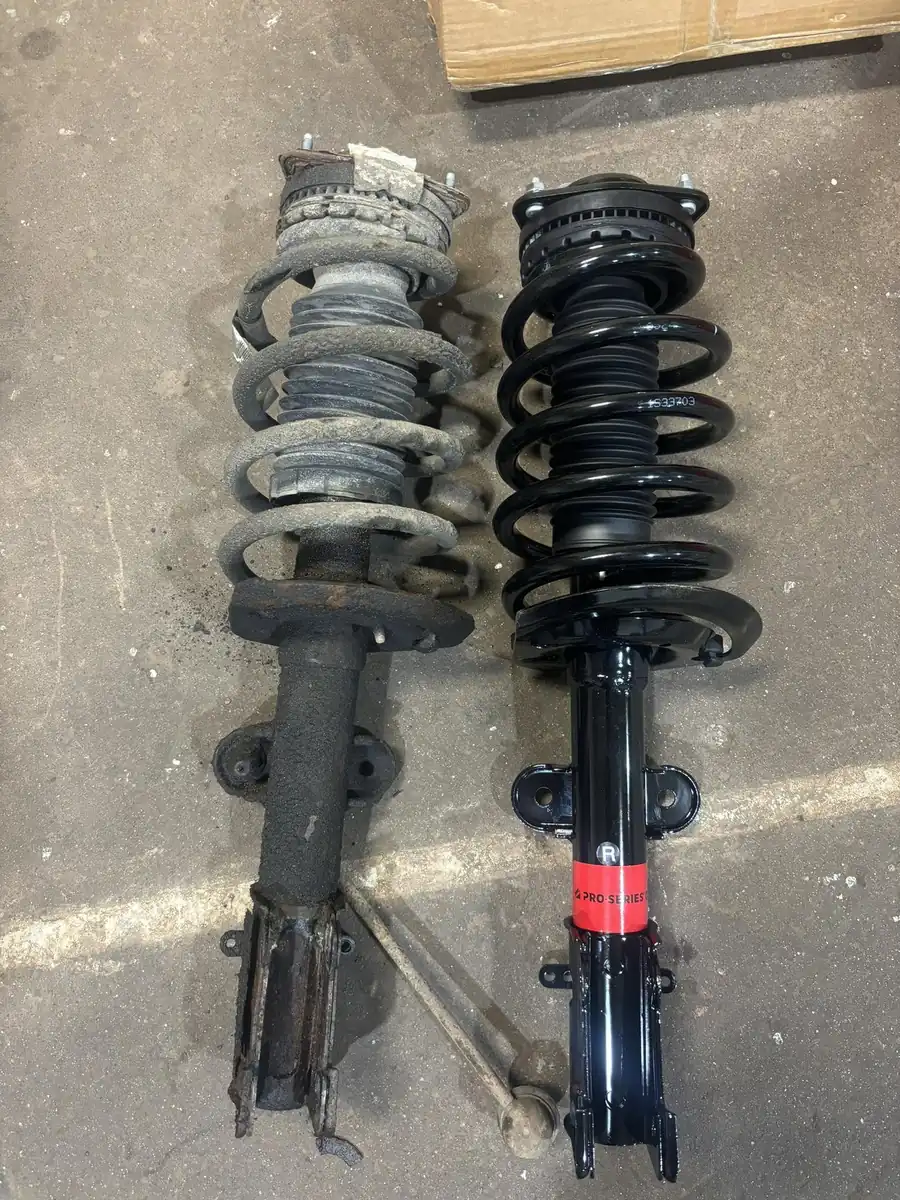
A complete strut assembly arrives with the strut, spring, mount and bearing already built up as one unit. Buying the pieces separately means reusing the spring and mount and compressing the spring by hand. Both are legitimate repairs, and in a salt climate the choice is usually decided by the condition of the parts you would be keeping.
| Complete assembly vs separate parts | Complete strut assembly | Shock or strut and spring separately |
|---|---|---|
| What you get | Strut, spring, upper mount and bearing preassembled as one unit | Just the damping unit, or the individual pieces you choose to replace |
| Labour involved | Less: the old unit comes out and the new one goes in | More: the spring has to be compressed and transferred, and a spring compressor is not a driveway job |
| Parts cost | Higher: you are buying components that may not be worn out | Lower: you replace only what actually failed |
| Corroded springs and mounts | Replaced as part of the job, so a rusted spring or seized mount does not stay on the vehicle | Reused, which is only sensible if they are genuinely still sound |
| Noise afterwards | Upper mounts and bearings are new, which removes a common source of clunks and turning noise | An old mount or bearing can still make noise beside a brand new strut |
| Best for | Higher-mileage vehicles that have lived through northern Ontario winters, where the spring and mount are as tired as the strut | Newer vehicles with a single failed damper and clean, sound springs and mounts |
There is no answer that is right for every vehicle, which is why it gets decided by looking. AutoNorth inspects the spring, mount and bearing while the corner is apart and tells you which of the two jobs your vehicle is actually a candidate for, with photos of what it found.
What Does a Clicking Noise on Turns Mean?
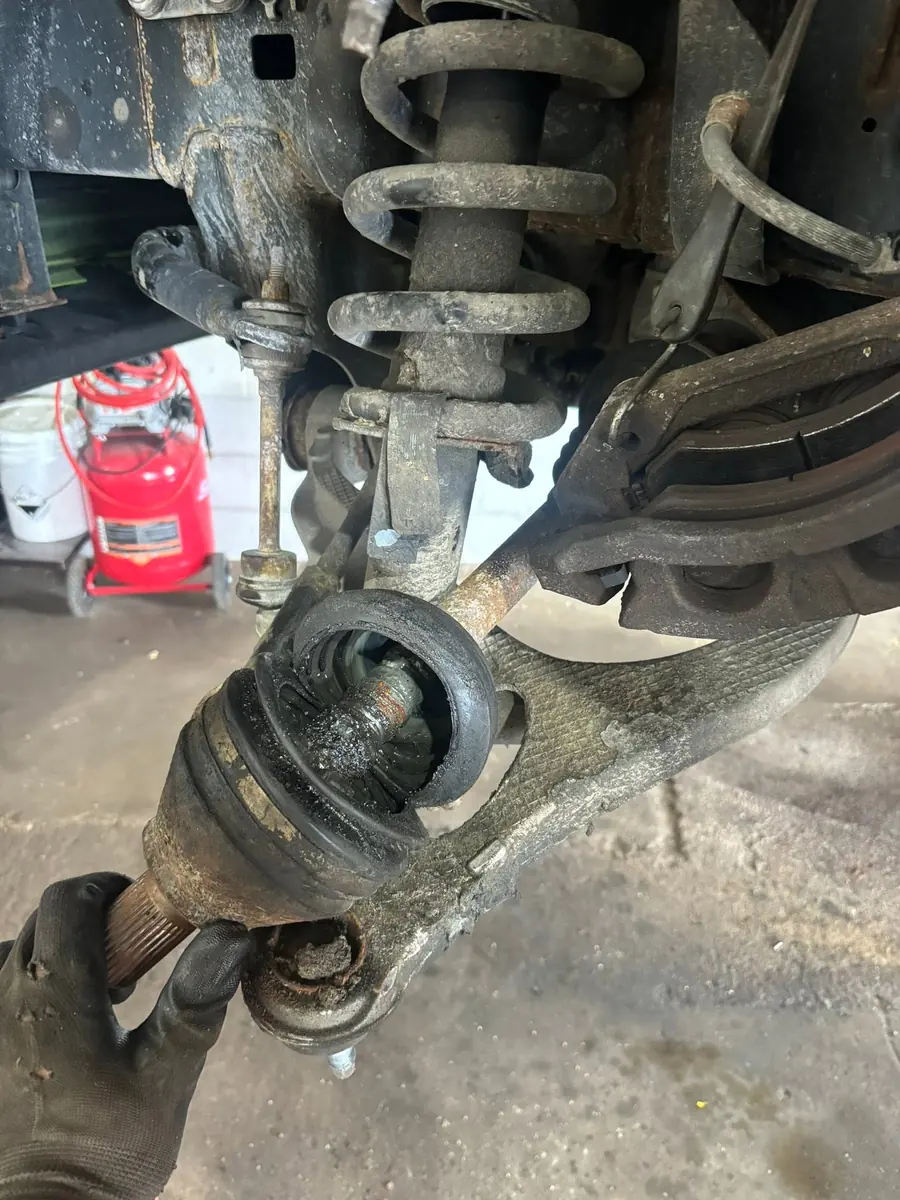
A rhythmic click that appears when you turn and speeds up with the wheels is usually a worn outer CV joint. The joint itself is rarely the first thing to fail. The rubber boot around it splits, the grease escapes, dirt and road salt get in, and the joint wears out from there.
- The boot is the cheap part. Catch a split boot early and you are dealing with a boot. Leave it and you are dealing with an axle, because a joint running dry and full of grit does not recover.
- Grease inside the wheel is the tell. A boot that has let go throws its grease outward as the axle spins, which is why it lands on the inside of the rim and across the surrounding suspension.
- Salt accelerates all of it. Rubber boots harden and crack faster in a climate that spends half the year covered in brine, and there is a lot of brine on a North Bay road in February.
- Power steering has its own symptoms. A whine that rises with engine speed, a heavy or notchy wheel, or a low fluid level all point at the steering system rather than the suspension, and they get diagnosed rather than assumed.
- Wheel bearings sound different. A failing bearing usually hums or growls, changes pitch as you sweep the wheel left and right at speed, and gets worse with load on that side. It is a separate part with a separate fix.
Where to Get Suspension and Steering Repair in North Bay
AutoNorth Auto Repair handles suspension and steering at 1520 Cholette St in North Bay, on cars, light trucks, work vehicles and hybrids, gas and diesel alike. The shop diagnoses the actual worn component rather than replacing parts until the noise stops.
- Struts, shocks and springs. Complete assemblies or individual components, decided by what the inspection finds rather than by what is quickest to order.
- Control arms, ball joints and bushings. The parts that locate the wheel. When they develop play, everything attached to them wears faster.
- Tie rods and steering linkage. The difference between a vehicle that tracks straight and one that has to be steered constantly.
- Sway bar links and bushings. Cheap parts, and one of the most common sources of the clunk that sends people to a shop in the first place.
- Wheel bearings. Diagnosed by the noise and by feel, then replaced. A humming bearing is not something to run through another winter.
- CV axles and boots. Boot replacement where the joint is still good, complete axles where it is not.
- Power steering. Leaks, pumps and fluid condition, on hydraulic and electric systems. Ask the shop about racks.
- The alignment afterwards. Suspension and steering work changes the geometry, so a wheel alignment normally belongs on the same visit, and new tires deserve one too.
Everything AutoNorth finds comes to you as a digital inspection report by text and email, with photos and video of the actual part on your actual vehicle, grouped by priority. You approve or decline each item from your phone or computer without calling the shop. And because AutoNorth's technicians are paid straight time rather than flat rate, nobody at Cholette St earns more by finding you an extra control arm or by rushing the one you came in for.
Suspension and Steering: Common Questions
How long do struts and shocks last?
There is no fixed number, because dampers wear gradually rather than failing on a date. Roads matter more than the odometer, and North Bay frost heave, potholes and gravel are harder on them than most driving. AutoNorth checks the shocks and struts while the vehicle is already on the hoist and sends you photos of what it found.
Do I need a wheel alignment after suspension repair?
Usually yes. Replacing struts, control arms, tie rods or ball joints changes the angles the wheels sit at, and an alignment is what sets those angles back to specification. AutoNorth will tell you whether the specific repair on your vehicle calls for one before the work is booked.
Can worn suspension wear out my tires?
Yes, and it is one of the most expensive things about ignoring it. A shock that no longer controls the wheel lets the tire skip across the pavement instead of staying planted, which shows up as cupped or scalloped wear. A set of tires can be ruined well before the tread is legally worn out.
Is it safe to drive with a torn CV boot?
A torn boot is not the same emergency as a brake failure, but it is a clock running. Once the grease is thrown out and dirt and road salt get in, the joint wears from the inside and eventually starts clicking on turns. Replaced early it is a boot job, left alone it usually becomes an axle.
What causes a clunking noise over bumps?
A clunk over bumps normally means something in the suspension has developed play: a sway bar link, a bushing, a ball joint or a strut mount are the usual suspects. Some of those are inexpensive parts and some are not, which is why guessing is a poor strategy. AutoNorth locates the worn component on the hoist and shows you a photo of it before quoting.
Get the Clunk Diagnosed Before It Costs You Tires
Call AutoNorth and describe the noise. The shop will put the vehicle on the hoist, find the part that actually failed, and quote the repair before anything gets replaced.