Trailer Safety Inspections in North Bay
AutoNorth Auto Repair is a licensed MTO Motor Vehicle Inspection Station and an enrolled DriveON facility at 1520 Cholette St in North Bay, and it performs the annual safety inspection that keeps a work or utility trailer legally in service. Ontario sets that requirement by weight rating rather than by the name on the trailer, and the inspection has to be redone every twelve months. This page covers which trailers the province requires to be inspected, what an inspector actually goes over, what fails most often, and how to have the trailer ready before you hitch up.
Last updated August 7, 2026
How Much Does a Trailer Safety Inspection Cost in North Bay?
What drives the cost of a trailer safety inspection is the trailer itself: how many axles it carries, whether those axles have brakes, and what condition the unit turns up in. AutoNorth gives you the price for the inspection before the trailer comes in, and quotes anything else separately once the trailer has actually been looked at.
- Axle count. A single-axle utility trailer is a shorter job than a tandem-axle unit. There is simply twice as much running gear to get through on the second one.
- Brakes or no brakes. Brakes have to be checked properly rather than glanced at, and a trailer with four braked wheels takes longer than one with none. Electric brakes also have to be actuated to prove they work.
- The condition it arrives in. A trailer caked in a season of mud takes longer to inspect than one that has been washed, because the frame, the welds and the wiring all have to be visible.
- How long since it last went through. A unit that has sat in a yard for two winters usually needs more attention than one that has been in steady service.
- Whether it passes first time. The inspection fee covers the inspection. Anything that has to be repaired before the trailer will pass is a separate quote, and a failed unit means a repair and a re-inspection rather than one trip.
Call AutoNorth with the trailer's make, its axle count, and whether it has brakes, and the shop will tell you what the inspection involves before you hitch up and drive over. Nothing beyond the inspection goes ahead without a quote you have approved first.
Which Trailers Does Ontario Require to Be Inspected Every Year?
Ontario requires an annual safety inspection on most trucks, trailers and converter dollies, alone or in combination, with a total gross weight, registered gross weight or manufacturer's gross vehicle weight rating of more than 4,500 kg. That inspection is valid for 12 months, after which the unit goes through again.
- The number that matters is 4,500 kg. The province looks at total gross weight, registered gross weight, or the manufacturer's gross vehicle weight rating. It is a rating, not what happens to be loaded in the trailer this morning.
- A big trailer pulls the whole combination into scope. A trailer over 2,800 kg, which is 6,171 lb, can also change how the combination is treated for registered gross weight and CVOR purposes. That is a separate rule from the inspection requirement above, so ask AutoNorth or the Ministry of Transportation if you are not sure where your outfit sits.
- There is a personal-use exemption, and it matters. A pickup truck and the trailer it tows are exempt from this inspection when the outfit is used for personal purposes without compensation, is not carrying commercial tools, cargo or equipment, and the pickup has a manufacturer's gross vehicle weight rating of 6,500 kg or less with its original or an unmodified replacement box. Haul for work, or carry tools for pay, and the exemption does not apply. If you are not certain which side you are on, call AutoNorth before booking rather than after.
- Twelve months, then it repeats. An annual inspection is exactly that. The decal that goes on the trailer records the vehicle type and the month and year it was inspected, so the expiry is readable from the outside.
- The decal goes on the front left. On a trailer, semi-trailer or converter dolly it is applied to the outside surface on the front left side, which is where an officer will look for it.
- There is a written standard behind it. Annual inspections are carried out against National Safety Code Standard 11, Part B, by a licensed motor vehicle inspection mechanic. It is not a walk-around in a driveway.
Most trailer owners around here call the result the yellow sticker. Where your particular unit falls is decided by its weight rating and how it is registered, not by what it gets used for, so read the ownership before you assume. The 4,500 kg figure comes from the Government of Ontario's commercial vehicle safety requirements, and the 2,800 kg figure from its commercial vehicle operator registration guidance. If you are still not sure which side of the line you are on, call AutoNorth at (705) 472-6060 with the weights off the ownership and the shop will tell you what it can and cannot inspect.
What Gets Checked on a Trailer Safety Inspection?
A trailer inspection covers everything that connects the trailer to the tow vehicle, everything that carries the load, and everything that lets the traffic behind you know what you are doing. In practice that means the coupler, the chains, the brakes, the bearings, the tires, the lights and wiring, and the frame and suspension underneath it all.
- Coupler, hitch and safety chains. The coupler gets checked for wear, cracks and a latch that actually latches. Chains have to be present, rated, undamaged, and long enough to cross under the tongue without dragging.
- Brakes and the breakaway system. Braked trailers get the drums or discs assessed, the actuator or controller circuit proven, and the breakaway switch and its battery checked. A breakaway battery that has not held a charge in three years is a fail waiting to happen.
- Wheel bearings and hubs. Bearings are checked for play, roughness and heat damage, and seals for leaks. Bearings are a common reason a trailer ends up stranded on the shoulder.
- Tires and rims. Tread depth, sidewall condition, cracking, inflation and the rims themselves. Trailer tires very often have tread left and are still finished, because they age out sitting still rather than wearing out rolling.
- Lights and wiring. Running lights, brake lights, turn signals, plate light, reflectors, the plug, and the ground. Corroded grounds are a frequent cause of trailer light faults.
- Frame, welds and suspension. The frame and crossmembers are checked for cracks, rot and previous repairs, and the springs, hangers, shackles and equalizers for wear and corrosion.
What fails most often
Ontario's own trailer safety material lists coupling defects, brake system defects and lighting system defects among the common errors that lead to infractions, and that lines up with what shops actually see. Add to it the things that go wrong from a trailer sitting still: brakes seized from a winter in a yard, dry or pitted bearings, a breakaway battery that is dead, wiring grounds gone green under road salt, and tires that are eight or ten years old with plenty of tread and cracks all down the sidewall. None of it is exotic. Almost all of it is cheaper to sort out in the spring than in the middle of a job.
Annual Trailer Inspection vs a Vehicle Safety Certificate: Which Do You Need?
They are not the same document and they are not for the same purpose. An annual inspection keeps a heavier trailer legally in service and is repeated every twelve months. A Vehicle Safety Certificate is a one-time document tied to a transaction, usually plating or transferring a car or light truck.
| Annual trailer inspection vs Vehicle Safety Certificate | Annual trailer inspection | Vehicle Safety Certificate |
|---|---|---|
| What it is for | Keeping a trailer legally in service | Plating, registering or transferring a vehicle |
| What triggers it | Weight rating and how the unit is registered | A sale, a transfer, or bringing a vehicle back onto the road |
| How often | Every 12 months, for as long as the unit stays in service | Once, for that transaction |
| What you end up holding | An inspection report plus a dated decal fixed to the trailer | A certificate you hand in with the paperwork |
| Where the proof lives | On the outside front left of the trailer, readable from the road | In the file, with the ownership |
| Best for | Work and utility trailers that stay in service year after year | Buying, selling or re-plating a car or light truck |
One useful overlap: an annual inspection can be used as a Safety Standards Certificate for 36 days after the inspection date, which matters if a unit is changing hands around the same time it is due. AutoNorth is licensed for both jobs, issuing Vehicle Safety Certificates for cars and light trucks and annual inspections for work and utility trailers, so you are not booking two shops in the same week.
When Should You Book a Trailer Safety Inspection?
Book it before the season you actually need the trailer, not the week you need it. Check the month and year printed on the current decal, count back a few weeks from the expiry, and get it in while there is still time to fix whatever the inspection turns up.
- Read your existing decal first. It carries the month and year of the last inspection. That is your clock, and it does not send reminders.
- Leave room for the repair. The worst version of this is an expired sticker, a trailer that needs bearings, and a job starting Monday. Build in a buffer.
- Do it after the trailer has sat. A unit that spent the winter in a yard is the one most likely to have seized brakes, dry bearings and a dead breakaway battery.
- Do it when you buy used. A trailer with a current sticker was in shape on the day it was inspected. That day may have been eleven months ago.
- Book ahead in spring. Every trailer in the district wants to be back on the road in the same six weeks, and AutoNorth works through 8 to 10 vehicles a day.
How to have the trailer ready
Bring the ownership. Empty the trailer, because a loaded deck hides the floor, the crossmembers and half the frame. Wash the mud off the underside and the wiring so the welds and grounds can actually be seen. If the trailer has electric brakes, bring the tow vehicle with the controller in it, since the brakes have to be actuated to be proven. Air the tires up, check that the plug is not full of corrosion, and if the breakaway battery has not been charged since last year, charge it. Twenty minutes of that at home saves you a second trip across town.
Where to Get a Trailer Safety Inspection in North Bay
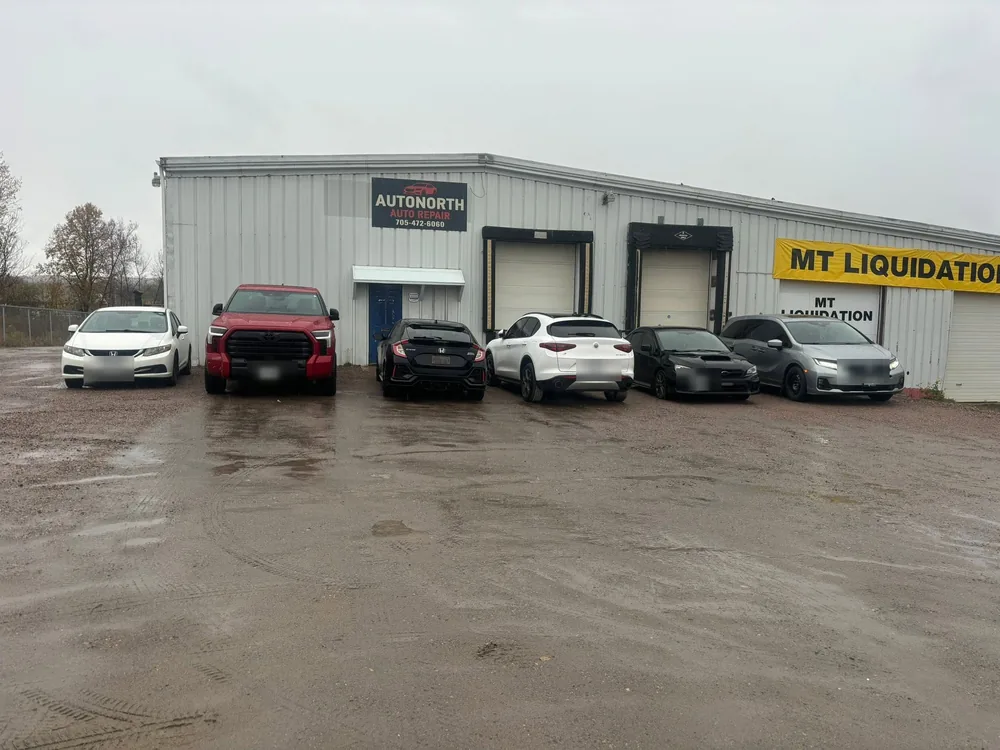
AutoNorth Auto Repair performs annual safety inspections on work and utility trailers at 1520 Cholette St in North Bay, as a licensed MTO Motor Vehicle Inspection Station. Call (705) 472-6060 or text (705) 571-4391 to book, Monday to Friday, 8:00am to 5:00pm.
- A licensed station, not a favour. AutoNorth is licensed to issue Vehicle Safety Certificates for cars and light trucks and to carry out annual inspections on work and utility trailers.
- Nobody is paid to find you a repair. AutoNorth's technicians are dealership-trained and paid straight time rather than flat rate, so no one in the building earns more by writing up extra work or by hurrying an inspection along.
- The rest of the fleet fits through the same door. The trucks pulling the trailers get serviced at the same shop, which is the point of the AutoNorth fleet program for government and municipal fleets.
- You are not stranded while it is in. AutoNorth runs a customer shuttle, including rides home, so dropping a unit off does not cost you the morning.
- Bigger bills can be spread out. Third-party financing is available through AT Clarke Enterprises for larger repairs, which is worth knowing before a trailer fails on something structural.
- Rated 5.0 from 24 Google reviews. The shop opened on Cholette St in September 2025 and has been building that record since.
AutoNorth's digital inspection reports carry photos and video of what a technician found, grouped by priority, and go out by both email and text so you can approve or decline each item from your phone. Call the shop with your trailer's details and ask what its inspection involves, what it can put through, and what it would need to send elsewhere. You will get a straight answer either way.
Trailer Inspections: Common Questions
Does my utility trailer need a safety inspection in Ontario?
Ontario requires an annual safety inspection on most trucks, trailers and converter dollies, alone or in combination, rated at more than 4,500 kg total gross weight, registered gross weight or manufacturer's gross vehicle weight rating. Whether your unit sits over that line is decided by its rating and how it is registered, so read the ownership rather than guessing. Call AutoNorth at (705) 472-6060 with those numbers and the shop will tell you what it can inspect.
How long is a trailer safety inspection good for?
An annual inspection is valid for 12 months from the date it was carried out. The decal fixed to the trailer records the vehicle type plus the month and year of inspection, so the expiry is readable without digging out paperwork. Book the next one with enough room left to repair anything the inspection turns up.
Where does the inspection sticker go on a trailer?
On a trailer, semi-trailer or converter dolly the decal is applied to the outside surface on the front left side. That placement is deliberate, because it is where an officer looks for it from the road. On a truck the equivalent decal goes on the outside lower left corner of the windshield or the left side of the cab.
What happens if my trailer fails the inspection?
A trailer that fails has to be repaired and then re-inspected before it gets its sticker. Ontario does not require the repair to be done at the same place that inspected it, so the choice is yours. Ask AutoNorth what it found, what it can put right in house, and what it would need to send elsewhere.
Should the trailer be empty for a safety inspection?
Yes. A loaded deck hides the floor, the crossmembers and a good share of the frame, and none of that can be signed off if it cannot be seen. Washing the mud off the underside and the wiring helps just as much. If the trailer has electric brakes, bring the tow vehicle with the controller in it, because the brakes have to be actuated to be proven.
Get the Trailer Inspected Before the Season Starts
Call AutoNorth with the trailer's axle count and whether it has brakes, and the shop will tell you what the inspection involves before you hitch up and drive over.